
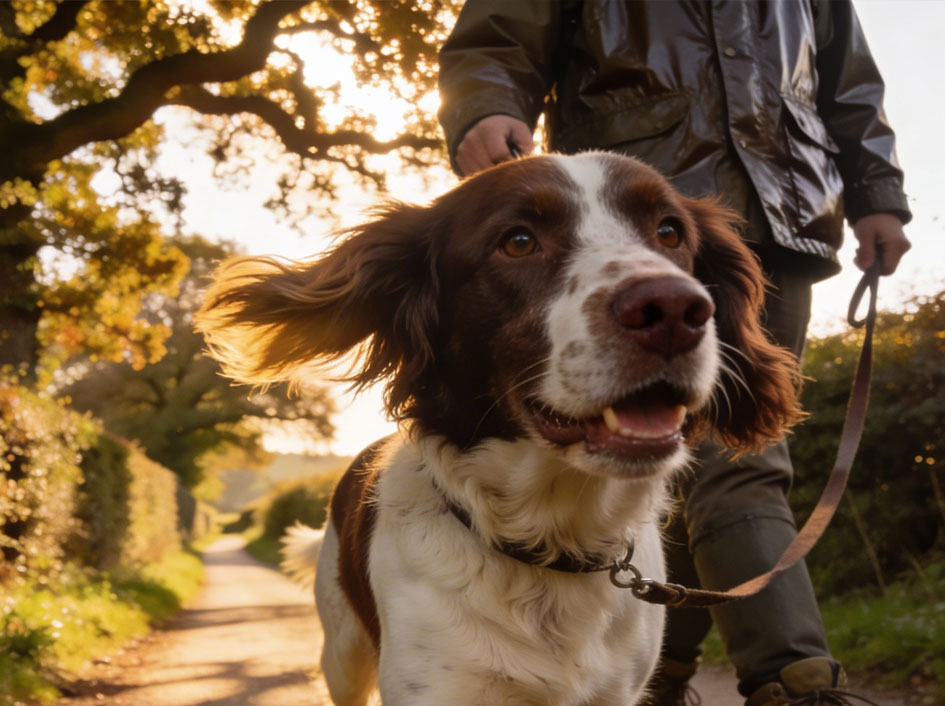

You set off for a nice morning walk. Within thirty seconds, your cocker spaniel is three feet ahead, nose down, dragging you towards a hedge like a furry little freight train. Sound familiar?
Lead pulling is one of the most common frustrations for spaniel owners and one of the most misunderstood. It’s not your dog being naughty. It’s your dog being exactly what it was bred to be: fast, curious, and absolutely driven to investigate everything within sniffing distance. That doesn’t make it less annoying, but it does mean the solution is less about punishment and more about teaching your dog a genuinely better option.
This guide covers why spaniels pull, what actually works, and how to build loose-lead walking into a lasting habit without turning every walk into a battle of wills.
Quick summary
Cocker spaniels pull because they were bred to move fast and follow their nose and because pulling has been accidentally rewarded every time a walk continued. The fix is consistent, patient training that teaches your dog a better option.
- Start training in a low-distraction environment garden or quiet street first
- Use high-value treats your dog genuinely cares about
- The three core methods: stop and wait, change direction, and reward check-ins
- Equipment like a front-clip harness can help, but won’t replace training
- Consistency across everyone who walks the dog is essential
- Progress takes time short daily sessions beat occasional long ones
Why cocker spaniels pull so much
Before you can fix the problem, it helps to understand it.
Working cocker spaniels were selectively bred to move fast, cover ground, and follow their nose wherever it leads. That drive is exactly what makes them brilliant in the field and exactly what makes lead walking feel so unnatural to them at first. Every interesting smell is an invitation. Every rustle in the hedge is a potential flush. The world is endlessly compelling, and you are, frankly, not moving fast enough.
Pulling also gets reinforced very quickly without owners realising it. Every time your dog pulls forward and you follow, the dog has learned: pulling works. The walk continues. The interesting thing gets closer. The behaviour is rewarded simply by happening, over and over, every single day.
Spaniel Brain tip: Your dog isn’t being wilful. It’s doing exactly what experience has taught it to do. Once you understand that, the training approach becomes much clearer you’re not fighting stubbornness, you’re rewriting a habit.
Before you start: a few ground rules
Training loose-lead walking takes time and consistency. There are no shortcuts, and any approach that relies on discomfort or correction tends to produce a dog that walks nicely only when wearing a particular piece of kit not one that genuinely understands what’s being asked of it.
A few things to bear in mind before you begin:
- Start somewhere boring. Trying to train loose-lead walking on a busy footpath or near woodland is asking for failure. Start in your garden, or on a quiet street. Reduce distractions as much as possible, especially in the early stages.
- Keep sessions short. Ten focused minutes beats an hour of frustration. Cocker spaniels are sharp, but they’re also easily overstimulated. Little and often is the way.
- Get your treats right. You need something your dog actually cares about. For most working cockers, that means small, smelly, high-value treats tiny pieces of chicken, cheese, or a quality training treat. If your dog can take it or leave it, it’s not motivating enough for this kind of work.
- Be consistent. Every person who walks the dog needs to use the same approach. One inconsistent walk can undo several good ones.
The three core training methods
Method 1: stop and wait
This is the most straightforward method and a good place to begin if you’re just getting started.
The rule is simple: the walk only happens on a loose lead. The moment the lead tightens, you stop. You wait. The second the dog comes back towards you and there’s slack in the lead, you mark it with a “yes” or a clicker and move forward again.
No fuss, no drama, no yanking back. You simply become a statue until the lead is loose.
At first, this feels absurdly slow. You may cover twenty metres in ten minutes. Stick with it. Your dog is learning possibly for the first time that pulling actually stops the walk. The equation is changing.
Spaniel Brain tip: When rewarding your dog for returning to your side, deliver the treat at your hip not out in front of you. This encourages them to stay close rather than dash ahead to collect the reward and pull again.
Method 2: change direction
This works brilliantly for dogs who lose interest in the statue method particularly busy, high-energy cockers who are already pulling hard towards something exciting.
Every time your dog pulls, you calmly turn and walk in the opposite direction. No commentary, no correction. You simply change course. Your dog, now behind you, has to hustle to catch up. When they do and when the lead is loose you reward and carry on. If they pull again, you turn again.
It can look a bit ridiculous at first. You’ll spend a lot of time walking back and forth on the same stretch of pavement. But the message gets through quickly: the direction we go is the one where you stay close.

Method 3: reward check-ins
This one works alongside whichever method you’re using and is worth making a habit for life.
Every time your dog looks up at you during a walk that voluntary eye contact, that little glance that says I’m paying attention reward it. Immediately, enthusiastically, and with something genuinely good.
Cocker spaniels are people-oriented dogs underneath all that nose-driven madness. You want to build the idea that checking in with you is one of the most rewarding things they can do on a walk. Over time, a dog that checks in regularly is a dog that stays connected and a connected dog is far less likely to be three feet ahead pulling hard.
A treat pouch worn on your hip makes this considerably easier. You want to be able to reward quickly, without faffing about in your coat pocket.
What about harnesses and head collars?
Equipment can help manage pulling in the short term, but it won’t teach your dog anything on its own. That said, the right kit can make training sessions more comfortable and safer particularly if you have a very strong puller.
| Equipment type | How it works | Best for | Worth knowing |
|---|---|---|---|
| Front-clip harness | Lead attaches at the chest; naturally steers the dog back towards you when they pull | Strong pullers; dogs in early training | Good starting point reduces intensity without suppressing behaviour entirely |
| Head collar (e.g. Halti, Dogmatic) | Where the head goes, the body follows similar principle to a horse’s head collar | Dogs that are difficult to manage on a standard lead | Introduce slowly and positively; some dogs find them uncomfortable. Never use to jerk or correct. |
| Back-clip harness | Lead attaches at the back; no natural redirection when the dog pulls | General use, canicross, free running | Tends to make pulling worse during lead training not recommended for this purpose |
| Standard flat collar | Lead attaches at the neck | Dogs with established loose-lead manners | Avoid relying on this for a strong puller pressure on the neck can cause harm over time |
Watch out: Whatever equipment you choose, treat it as a management tool not a solution. A dog that only walks nicely in a particular harness hasn’t learned loose-lead walking. Pair any equipment with consistent training.
Common mistakes to avoid
- Repeating “heel” like a mantra. If your dog doesn’t yet understand what “heel” means, saying it repeatedly whilst they pull forward teaches them nothing. Introduce a verbal cue only once the dog is already doing the right thing then attach the word to the behaviour.
- Jerking or yanking the lead. This might suppress the behaviour momentarily but doesn’t teach an alternative. It can also damage your relationship with your dog and, in some cases, cause physical harm particularly to the neck if using a flat collar.
- Giving in. This is the big one. If your dog pulls hard enough and long enough and you eventually follow, you’ve taught them that persistence pays off. Every time you give in, the pulling becomes more entrenched.
- Training during a high-distraction walk. If you’ve just arrived at the park and your dog can smell five other dogs, a rabbit warren, and last Tuesday’s picnic, that is not the moment to work on loose-lead walking. Let them have a run first. Train when the intensity is lower.
Building up gradually
Once your dog is walking nicely in a low-distraction environment, start introducing more challenging settings slowly and systematically.
Move from the garden to a quiet road. From a quiet road to a slightly busier one. Introduce the presence of other dogs at a distance before working closer. Build duration gradually don’t expect a dog that’s just got the hang of it in the back lane to walk beautifully for an hour through the village on market day.
Every time you move to a harder environment, expect a temporary step back in performance. That’s entirely normal. Drop your expectations slightly, reward more generously, and let your dog recalibrate to the new level of difficulty.
Spaniel Brain tip: Think of distraction level like a volume dial, not an on/off switch. Turn it up gradually one notch at a time and only once your dog is consistently succeeding at the current level.

How long will this take?
Honestly? It varies. Some dogs get the idea within a few sessions. Others particularly older dogs with years of pulling habits built in take considerably longer.
A young puppy who’s never been allowed to pull will generally learn much faster than an adult rescue who’s spent two years dragging their previous owner around. Both can learn. The adult just needs more patience and more repetitions.
What matters most is consistency. Ten minutes every day will get you further than a sporadic hour here and there.
Final thoughts
Loose-lead walking isn’t about dominance, control, or making your dog march to heel like a soldier. It’s about building a shared understanding: we move together, and that’s more enjoyable for both of us.
Working cocker spaniels are clever, biddable dogs who genuinely want to work with you once they understand what you’re asking. Give them a clear, consistent system, make it worth their while, and most of them will get there.
It takes time. It takes patience. But the day your spaniel trots along beside you on a loose lead, glancing up occasionally as if to check you’re still having a good time that’s a genuinely satisfying thing. Worth every slow, stationary minute on the pavement.